- +91 98550-03180
-





.png)
.png)

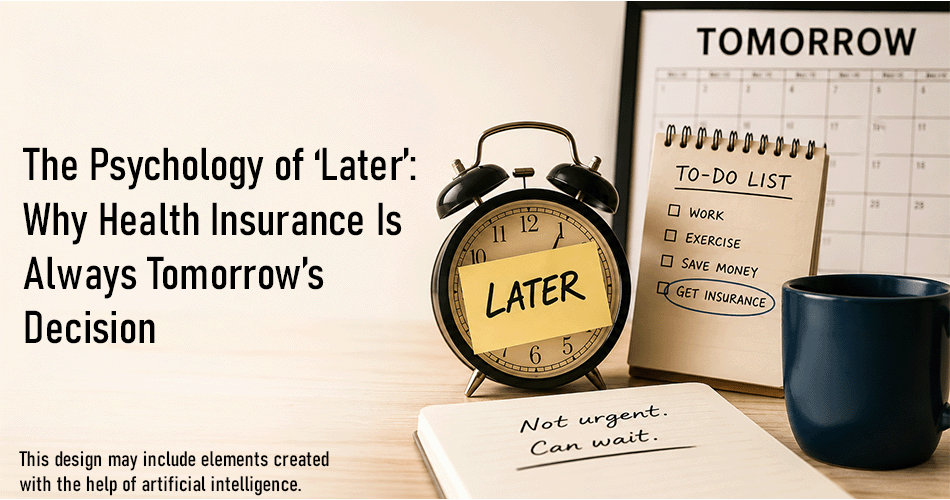
The Psychology of ‘Later’: Why Health Insurance Is Always Tomorrow’s Decision
Rohan could compare phone prices across five websites in under ten minutes. He renewed his bike insurance before the expiry date. He even booked movie tickets weeks in advance to get better seats.
But when it came to buying health insurance for himself, his answer was always the same:
“I’ll do it later.”
Not because he did not understand its importance. Not because he could not afford it.
The real reason was simple — nothing had gone wrong yet.
And that is what makes health insurance one of the most delayed financial decisions. It asks people to prepare for a situation they hope never happens. When life is normal, health insurance does not feel urgent. It quietly stays in the background while other expenses, purchases, and plans take priority.
Rohan was not careless with money. He paid bills on time, managed expenses, and had even started investing through SIPs.
But health insurance kept moving to “next month.”
Sometimes he thought he was too young. Sometimes he felt his office coverage was enough. Sometimes he simply believed there was still time.
This happens with many people. When nothing bad happens, delaying health insurance feels harmless. There is no immediate loss, no visible warning sign, and no instant consequence.
Life continues normally, and the mind slowly starts treating health insurance as something optional rather than important.
At 28, Rohan rarely visited hospitals. He felt fit, active, and safe. In his mind, health insurance was something to think about later in life.
This belief feels natural, but it can be risky.
When people are young and healthy, medical risk feels distant. Because nothing has happened so far, the mind assumes things will continue the same way. Good health starts feeling permanent.
But health conditions and medical emergencies do not always arrive with advance notice. The absence of problems today does not guarantee the absence of problems tomorrow.
In fact, younger years may often be a suitable time to evaluate health insurance, as premiums and eligibility are generally influenced by age, health condition, policy terms, and insurer underwriting norms.
One weekend, Rohan spent hours comparing phones online and bought one the same night. The decision felt exciting because the reward was immediate.
Health insurance never created that feeling.
There is no unboxing moment. No visible upgrade. No instant satisfaction.
Health insurance asks people to pay today for protection they may need in the future. That is why the brain naturally gives more attention to purchases that feel useful right now.
But while lifestyle purchases improve comfort, health insurance may help protect financial stability when medical expenses suddenly arise, depending on the coverage selected.
For a long time, Rohan believed delaying health insurance had no real downside.
But waiting can quietly change the situation.
With age, premiums may increase. Future health conditions may affect eligibility, coverage options, or waiting periods. More importantly, without adequate health cover, a medical emergency can put pressure on savings, investments, and long-term goals.
So delaying health insurance is not always a neutral decision. Even when nothing happens immediately, time can slowly change the financial equation.
Rohan’s mindset changed when a close friend was unexpectedly hospitalised. The medical emergency was stressful, but the financial pressure made it even harder.
Suddenly, hospital bills, coverage limits, and savings became real topics — not distant possibilities.
For the first time, health insurance did not feel like another expense. It felt like protection.
That is often how people begin to value health insurance. Unfortunately, many realise its importance only after uncertainty becomes personal.
Health insurance is not only about paying hospital bills. It is about protecting financial stability during medical uncertainty.
A serious illness or hospitalisation can affect more than one expense. Savings may get disturbed, investments may need to be withdrawn, and future goals can come under pressure.
Depending on the policy terms and coverage, health insurance may help reduce this financial burden and provide support when it is needed most.
Investments help build wealth over time. Health insurance can help reduce the financial impact of unexpected medical disruptions, subject to policy terms, conditions, exclusions, and coverage limits.
For a long time, Rohan thought delaying health insurance was harmless because life was going smoothly.
And that is exactly why many people postpone it.
When everything feels normal today, “later” sounds practical. But health emergencies rarely follow personal timelines.
Health insurance is not bought because someone expects illness tomorrow. It is bought because life can become unpredictable without warning.
Rohan finally realised that the hardest part was not the paperwork or the premium. It was overcoming the mindset that there would always be more time.
That is the real psychology of “later.”
Tomorrow always feels available — until life suddenly asks whether we were prepared today.
This content is for educational purposes only and is not intended as advice or solicitation to purchase or sell any insurance product. Insurance is a subject matter of solicitation. Please read all policy-related documents carefully before deciding. This blog should not be treated as investment advice or a recommendation.
At MoneyTalks, we pride ourselves on our commitment to suggesting you through the complexities of finance with clarity and expertise.
MoneyTalks Wealth Pvt. Ltd.
OPP. GOVT. BOY SCHOOL GROUND,
MEHS GATE TO KOTWALI ROAD,
NABHA-147201, PATIALA
+91 98550-03180
AMFI Registered Mutual Fund & SIF Distributor
ARN-255869 | Date of Initial Registration – 18 MAY 2022 | Current Validity of ARN – 28-OCT-2025 To 27-OCT-2028
SIF-255869 | Date of Initial Registration – 11-AUG-2025 | Current Validity of SIF – 210-AUG-2028
APMI Registered PMS Distributor
APRN - 01104| Date of Initial Registration – 5 July 2025 | Current Validity of APRN – 4 July 2028
Risk Factors – Investments in Mutual Funds are subject to Market Risks. Read all scheme related documents carefully before investing. Mutual Fund Schemes do not assure or guarantee any returns. Past performances of any Mutual Fund Scheme may or may not be sustained in future. There is no guarantee that the investment objective of any suggested scheme shall be achieved. All existing and prospective investors are advised to check and evaluate the Exit loads and other cost structure (TER) applicable at the time of making the investment before finalizing on any investment decision for Mutual Funds schemes. We deal in Regular Plans only for Mutual Fund Schemes and earn a Trailing Commission on client investments. Disclosure For Commission earnings is made to clients at the time of investments. Option of Direct Plan for every Mutual Fund Scheme is available to investors offering advantage of lower expense ratio. We are not entitled to earn any commission on Direct plans. Hence we do not deal in Direct Plans.
We act as a Mutual Fund Distributor offering regular plans only and do not provide fee-based SEBI-registered investment advisory services.
Grievance Officer- Mr Parminder Pal Singh | moneytalkswealth@gmail.com | 9855003180
(If not resolved within 15 working days, you may escalate to the concerned AMC / AMFI / SEBI SCORES platform. )
Important Links | Disclaimer | SID/SAI/KIM | Code of Conduct | SEBI Circulars | AMFI Risk Factors